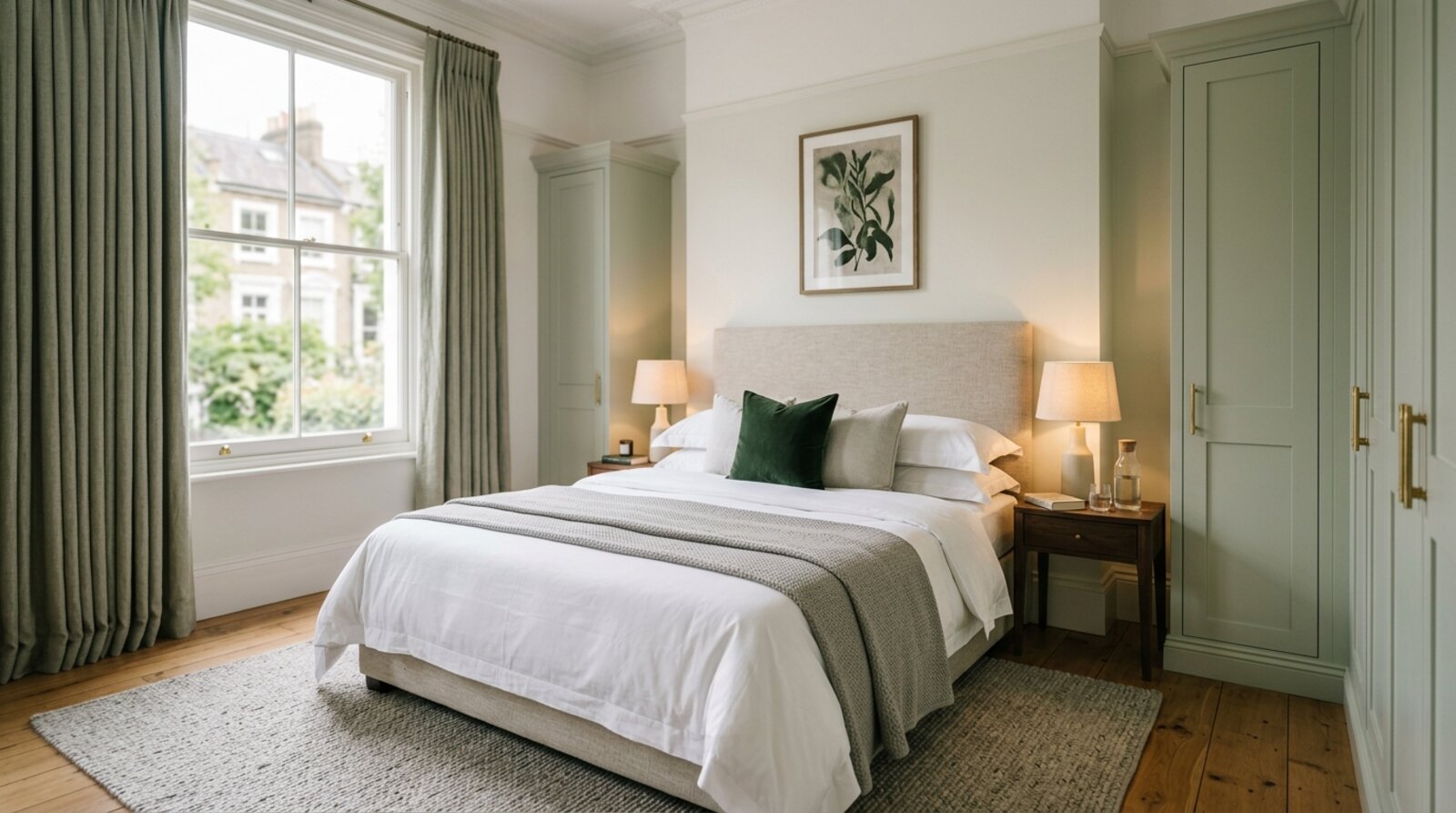
A master bedroom carries a quiet pressure that other rooms escape. It is the last place you see at night and the first in the morning, yet it is usually designed in a hurry, around a bed that was bought before anyone measured the wall it would sit against. The result is a room that looks fine in photographs and feels slightly wrong to live in.
The bedroom is one of our core services, and the same thinking we apply to a kitchen layout applies here: start with how you actually use the space, not with a mood board. Before you choose a paint colour or a headboard, spend a few mornings and evenings noticing your real routine. Which side of the bed do you get out of first? Where do clothes land at the end of the day? Do you read in bed, work in bed, watch anything? Does one of you wake earlier and need to dress without disturbing the other? These small patterns decide where the bed sits, which side gets the better reading light, and whether you need a quiet dressing zone away from the sleeping side.
This guide walks through designing a master bedroom that is restrained, comfortable and built to last well beyond the current trend cycle.
1. Read the Room and the Bed Wall First
Every bedroom has one wall that wants the bed. It is usually the longest uninterrupted wall, ideally one you can approach from both sides, and one that does not put your feet pointing straight out of the door. Find that wall before anything else, because the bed is the largest object in the room and almost everything else arranges itself around it.
Walk the room and note what fights you: the door swing, the window positions, any radiators, the chimney breast, and where the natural light falls through the day. A bed under a window can work, but it complicates curtains and can feel draughty in an older house. A bed on the same wall as the door often feels more settled than a bed facing it head on.
Measure properly before you commit to a bed size. UK beds run to standard widths: a double is 135cm wide, a king 150cm and a super king 180cm, with doubles 190cm long and kings and super kings 200cm. Many people stretch for a super king and then lose the room to it. The honest test is whether you can keep a clear walkway around the bed once it is in, which is the next section.
2. Position the Bed and Protect the Clearances
Comfort in a bedroom is mostly about the space you do not fill. The working rule is to leave a clear walkway of at least 70cm on each side you use and at the foot of the bed. Sixty centimetres is the point below which a room starts to feel pinched every single morning, and 90cm gives a properly generous, hotel-calm feeling if you have the width for it. Houzz UK suggests around 60cm each side of a double bed as a comfortable minimum.
A few practical points follow from this:
- A super king at 180cm wide needs roughly 3.2m of clear wall width before wardrobes to keep 70cm on both sides. In a tighter room a king often lives better than a forced super king.
- If you choose an ottoman or drawer bed, leave room for the base to lift or the drawers to pull right out, not just to walk past.
- Keep at least one side approachable for changing the bed. A bed jammed into a corner looks neat and becomes a daily struggle to make.
- Bedside tables should sit close to mattress height so a glass of water and a lamp are within easy reach without leaning.
Tape the bed footprint onto the floor and live with it for a day or two, the same trick that saves kitchens. You will feel a tight walkway long before you would have spotted it on a plan.
3. Choose a Layout that Suits the Room Shape
Most master bedrooms fall into a few shapes, and each has a natural arrangement.
Long, narrow rooms (common in terraced and converted houses) suit the bed on the short end wall, with wardrobes built down one of the long walls so the floor stays clear to walk through. Avoid lining both long walls with furniture, which turns the room into a corridor.
Square rooms are the most forgiving. Centre the bed on the main wall, balance it with a table and light on each side, and you have a calm, symmetrical layout. Spare width can go to a reading chair or a bench at the foot of the bed.
Wide rooms with the door on a long wall let you create two zones: sleeping on one side, a dressing or seating zone on the other. A low chest or an open-backed shelf can suggest the divide without closing the room in.
Rooms with the bed under a window can still work if you keep the headboard low and dress the window with full-height curtains either side rather than fighting to hang them behind the bed.
Whatever the shape, protect a clear path from the door to the bed and from the bed to the wardrobe and ensuite. Those are the routes you walk half asleep, and they should never make you weave around furniture.
4. Light the Room in Three Layers
A single ceiling light is the most common reason a bedroom feels flat. A room you actually relax in needs three layers of light, an approach we set out in more detail in our guide to lighting a room well.
Ambient light is the soft, general layer for the whole room. Keep it warm in colour temperature and put it on a dimmer so you can drop it low in the evening. A central pendant works, but wall lights or a couple of carefully placed downlights often feel softer in a bedroom.
Bedside reading light is the layer most people get wrong. Each side should have its own light, switchable from the bed, positioned so the light falls on the page or pillow rather than into your eyes or your partner's. Wall-mounted or pendant reading lights free up the bedside table and can be angled precisely. If you read different amounts at night, give each side independent control.
Accent light adds the final warmth: a low lamp on a chest, a picture light, or a strip tucked under a floating shelf. It is the layer that makes a room feel finished rather than functional.
Wire the main light and the bedside lights on separate circuits or dimmers, and consider a two-way switch by the door and the bed so you are not crossing a dark room to turn anything off.
5. Build a Calm Colour Scheme
Bedrooms are where restraint pays off most. A useful structure is the 60-30-10 rule: roughly 60 percent of the room in a dominant calm colour, 30 percent in a secondary tone, and 10 percent in a single deeper accent. In a living room the dominant colour can be confident; in a bedroom the 60 percent should usually be the quietest tone you are drawn to.
In practice that looks like:
- 60 percent on the walls, ceiling and largest surfaces: a soft off-white, a chalky stone, a muted green or a gentle blue-grey.
- 30 percent across bedding, curtains and an upholstered headboard, a step away from the wall colour rather than a contrast.
- 10 percent as one deeper accent, carried through cushions, a throw, a lampshade or a piece of art. Pick one accent and repeat it two or three times so it reads as intentional.
Test colours on the actual walls, not on a phone screen or a small chip. Paint a large patch on each wall and look at it in morning light, afternoon light and lamplight, because a north-facing London bedroom will pull a warm white grey and a south-facing room will warm a cool grey. The colours that last are the ones that still feel right in every light, which is why we steer clients away from whatever shade is having its moment.
6. Plan Storage and a Dressing Zone
Storage is what keeps a bedroom calm, because clutter is the enemy of rest. The first question is fitted or freestanding.
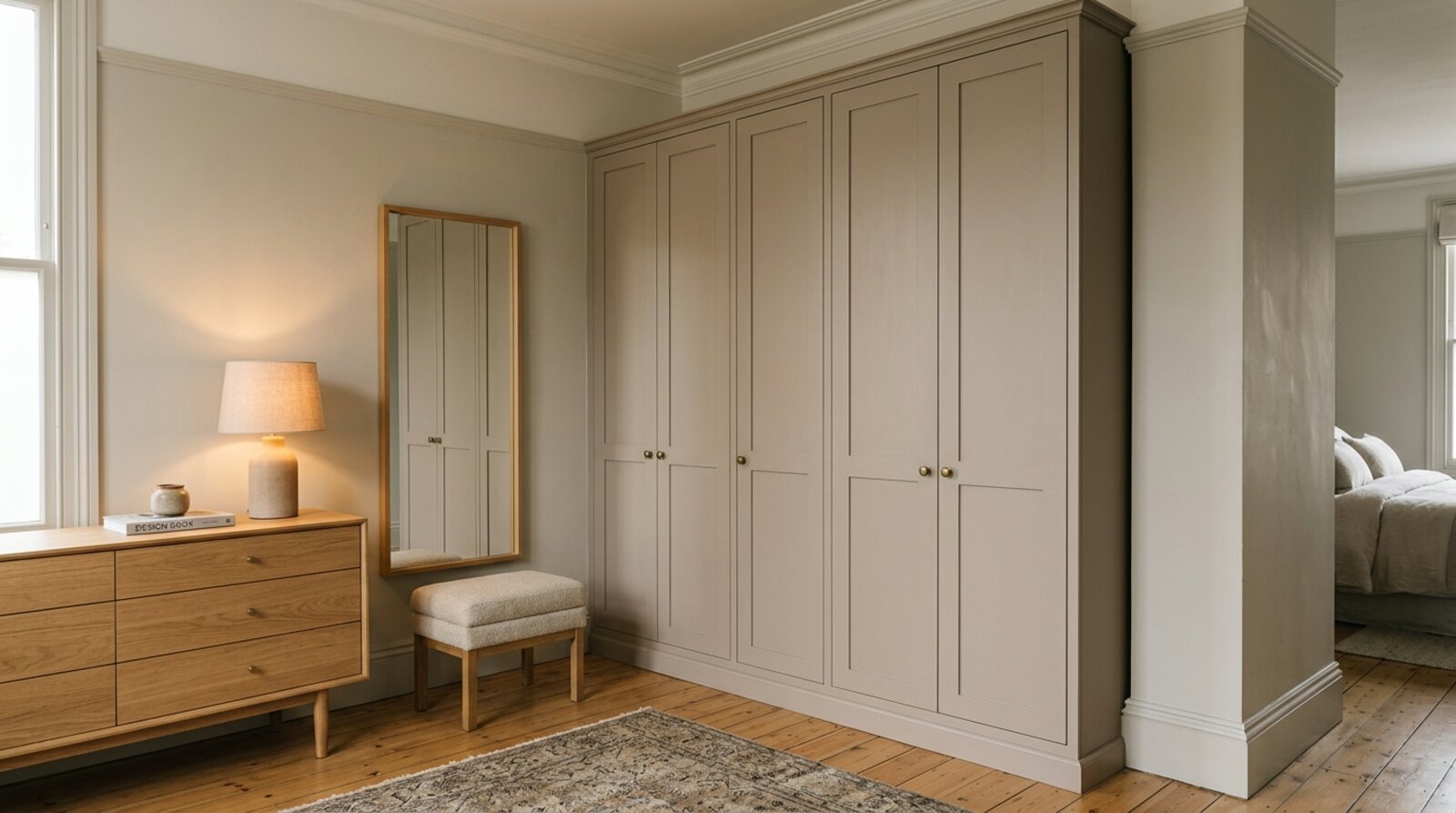
Fitted wardrobes use awkward height and depth efficiently, run floor to ceiling, and can be built around a chimney breast or into the slope of a loft conversion. They give the cleanest, most restful wall and the most hanging space per square metre, which is why they suit period rooms with quirks to absorb.
Freestanding furniture is more flexible, easier to rearrange or take with you, and often easier to approve in a listed building. A good wardrobe, a chest and a bench can look more relaxed than a wall of joinery.
Many of the calmest rooms combine the two: a run of fitted wardrobes on one wall, plus one or two freestanding pieces with character. Whichever you choose, plan the inside before the outside. Count your hanging, folded and shoe storage honestly, and design to what you own rather than a generic layout.
If the room allows, carve out a small dressing zone away from the sleeping side: a wardrobe wall with a mirror and a low stool, or a section behind a half-height divider. Even a metre of dedicated space stops the daily routine of getting dressed from spilling across the whole room.
7. Designing a Bedroom in a Period Property
London and South East bedrooms often sit inside Victorian, Edwardian and converted buildings with their own rules. Working with the architecture, rather than flattening it, almost always gives a better room. Our guide to Victorian house interior design covers the wider house; the bedroom-specific issues are these.
Chimney breasts break up the main wall and create two alcoves. Those alcoves are ideal for fitted wardrobes or shelving, bringing the storage flush so the room reads as one clean plane. The chimney breast itself can take the bed or a piece of art.
Low or sloped ceilings in loft conversions and cottages suit lower furniture, a low headboard and storage tucked into the eaves where you cannot stand anyway. Keep wall colour and ceiling colour close to avoid drawing a hard line at the awkward angle.
Awkward proportions appear when an old room has been subdivided, leaving odd widths or an off-centre window. Use a symmetrical bed arrangement to impose calm, and let bespoke joinery square up the rest. Centre the bed on a feature rather than the geometric middle of the wall if that reads better.
Uneven floors and out-of-square walls are normal in older houses. Bespoke wardrobes can be scribed to fit; flat-pack units will leave tapering gaps. Budget for that fitting work rather than being surprised by it.
Listed status may restrict what you can fix to walls, ceilings and windows. Freestanding furniture is often easier to approve than built-in joinery, and any changes to original features should be checked with the local conservation officer early.
Common Mistakes to Avoid
- Buying the bed first. The bed should follow the wall and the clearances, not the other way round.
- One ceiling light doing everything. Without bedside and accent layers the room reads as functional, never restful.
- Bedside tables that are too low. Aim for roughly mattress height so a lamp and a glass are within easy reach.
- A bed jammed into a corner. It looks tidy and makes changing the sheets a daily wrestle.
- Too many accent colours. Pick one deeper accent and repeat it; two or three competing accents make a small room feel busy.
- Curtains hung mean. Short, narrow curtains shrink a window; full-height curtains that clear the glass make the room feel taller and calmer.
- Storage designed to a generic plan. Count what you actually own and design the inside of the wardrobe to it.
Before You Commit
Test the room the way you would test a kitchen. Tape the bed, the wardrobe doors and any chest onto the floor, and walk your real morning and evening routine through it. Open the imaginary wardrobe doors, walk to the ensuite, get in and out of both sides of the bed. You will feel a tight clearance or a clumsy path immediately.
Live with paint patches and a fabric for at least a week before ordering. Look at them in daylight and under your actual bedside lamps, because lamplight is where you will see the room most. Order a cushion or a length of the bedding fabric and lay it against the wall colour before you buy the lot.
If the project involves structural change, a loft conversion, an ensuite, moving a doorway, or sensitive work in a listed home, it is worth bringing in a designer early. We work with affluent homeowners across London and the South East to design bedrooms that feel considered rather than decorated; our bedroom design service sets out how that works, and you can see the full range of what we do on the Vertigo Interiors homepage.
A bedroom designed this way does not chase the current look. It reflects how you sleep, dress and unwind, and it stays comfortable long after the trend that tempted you has passed.
Frequently asked questions
How much space should I leave around a master bed?
Leave a clear walkway of at least 70cm on each side you use to get in and out, and at the foot of the bed. Sixty centimetres is the minimum before a room feels cramped, and 90cm gives a more generous feel. Allow extra room if you have bedside drawers or an ottoman bed that needs to open.
What size bed fits a UK master bedroom?
A UK double is 135cm wide, a king 150cm and a super king 180cm; doubles are 190cm long and kings and super kings 200cm. A super king needs roughly 3.2m of wall width to keep 70cm clear on both sides, so in tighter period rooms a king often sits better than a forced super king.
How should I light a master bedroom?
Use three layers: soft ambient light for the whole room on a dimmer, dedicated bedside reading lights that fall on the page rather than in your eyes, and a little accent light for warmth. Put the main and bedside lights on separate switches so you can drop the level right down in the evening.
What is the 60-30-10 rule for bedroom colour?
It balances a scheme: about 60 percent a dominant calm colour on walls and large surfaces, 30 percent a secondary tone on bedding, curtains and the headboard, and 10 percent a single deeper accent in cushions, a throw or art. In a bedroom the dominant 60 percent should usually be the quietest colour you like.
Should bedroom storage be fitted or freestanding?
Fitted wardrobes use awkward height and depth efficiently and can be built around chimney breasts and into eaves, which suits period rooms. Freestanding furniture is more flexible and often easier to approve in listed buildings. Many calm rooms combine fitted storage on one wall with one or two freestanding pieces.
How do I design a bedroom in a Victorian or period property?
Work with the architecture rather than against it. Use the alcoves either side of a chimney breast for wardrobes, place the bed on the most solid uninterrupted wall, and choose lower furniture under sloped or low ceilings. Bespoke joinery handles out-of-square walls that flat-pack units cannot, and listed status may favour freestanding furniture.