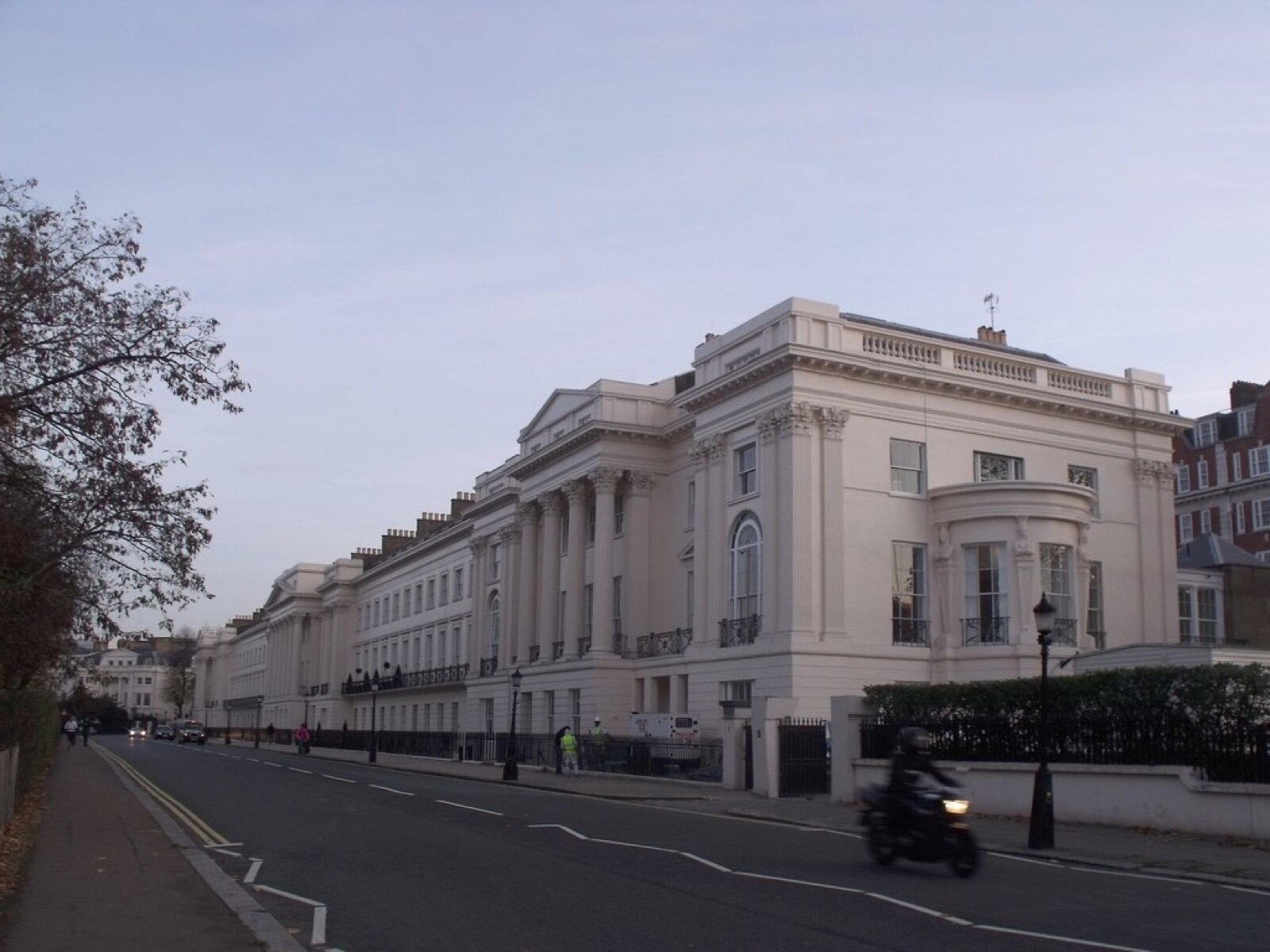
Cornwall Terrace on the Outer Circle, Regent's Park. Photo: Outer Circle, London (near Regent's Park) - Cornwall Terrace by ell brown (CC BY 2.0), via Flickr.
Roughly a fifth of London sits inside a conservation area, and clients hear the phrase and assume the worst: that everything now needs permission and the project has doubled in length. For an interior scheme in an unlisted building, that is usually wrong. Conservation area designation protects the character and appearance of an area, and it does that by controlling what can be seen, not what is behind the front door.
The distinction is worth stating plainly at the first meeting, because it changes what a client thinks is possible. It also has two exceptions that catch people out, and one of them costs six weeks.
What conservation area status does not control
In an unlisted building, none of the following engages conservation area rules:
- Internal layout, including removing or adding non-structural partitions
- Kitchens, bathrooms, utility rooms and their fittings
- Joinery, panelling, cornicing, skirtings and internal doors
- Finishes, decoration, flooring and lighting
- Removing a chimney breast or an internal wall, subject to building regulations and the Party Wall Act
You may still need building regulations approval, a structural engineer, and party wall notices where a shared wall is involved. Those are separate regimes with their own timetables. Our guide to the Party Wall Act for London renovations covers the second, and it is the one most likely to add two months if it is missed.
Where it does bite: the external envelope
Conservation area status starts to matter the moment work is visible from a public place. Two mechanisms do the work.
Demolition. Conservation area consent as a separate application was abolished in 2013, but demolishing an unlisted building in a conservation area, or a substantial part of one, now requires planning permission under the Planning (Listed Buildings and Conservation Areas) Act 1990 as amended, and doing it without is a criminal offence rather than a breach of planning control. Boundary walls, gates and railings above certain sizes are caught by this too, which surprises people who assume a front wall is theirs to remove.
Article 4 directions. This is the one that determines most residential projects. An Article 4 direction is made by the local planning authority and withdraws named permitted development rights in a defined area. Where one is in force, work that would normally need no application requires full planning permission. The rights typically withdrawn in London conservation areas:
| Element | Usual position under an Article 4 |
|---|---|
| Windows | Permission needed; timber sashes expected to match the original section and glazing bars |
| Front door | Permission needed for replacement or alteration |
| Roof covering and rooflights | Permission needed; conservation rooflights sitting flush usually required |
| Front boundary wall, railings, gate | Permission needed to remove or alter |
| Painting or rendering the front elevation | Often controlled |
| Satellite dishes and flues on the front | Often controlled |
Directions vary street by street, sometimes within the same conservation area, and there is no national register. Check the borough's own map and the text of the direction itself before specifying anything external. The text is what governs, not the summary page.
The six-week rule nobody plans for
Every tree in a conservation area is protected if its trunk diameter exceeds 75mm measured at 1.5m above ground. Before doing any work to such a tree, including pruning, you must give the local planning authority six weeks' written notice under section 211 of the Town and Country Planning Act 1990. The authority can use that window to make a tree preservation order, or let the work proceed.
This matters far more often than clients expect, because the tree is rarely the point of the project. It is the tree in the way of a rear extension's scaffold, or the one whose roots sit under a proposed garden room. Six weeks is not negotiable and there is no fast track, so it belongs in the programme at concept stage rather than being discovered by the contractor. Work without notice is an offence.
Listed and in a conservation area: a different problem
If the building is also listed, everything changes. Listed building consent is required for any works affecting the special interest of the building, inside as well as out, and the listing covers the whole structure, not just the facade. Removing a cornice, altering a staircase, changing a fireplace or lining a wall can all need consent. There is no de minimis for internal work. See listed building interior alterations for the detail.
In a leasehold flat, add a third layer: the freeholder's licence to alter, which runs on its own timetable and is independent of anything the council decides. Our guide to the licence to alter sets out how long that takes.
How to keep consent off the critical path
- Establish status in week one. Conservation area, listed grade if any, Article 4 in force, and any TPO. All four are findable from the borough's planning map and Historic England's list.
- Split the scheme. Interior work in an unlisted building can usually start while an external application is running. Do not let a window application hold up a kitchen.
- Serve the tree notice early. If any tree is near the works, serve at concept stage, not when scaffolding is booked.
- Use pre-application advice where the external work is contentious. It costs a few hundred pounds and is far cheaper than a refusal and a resubmission.
- Write a proper heritage statement. Applications refused in conservation areas are frequently refused for lack of justification rather than for the design itself.
Timings to plan around: eight weeks from validation for a householder application, plus two to four weeks to prepare and validate, plus six weeks for any tree notice running in parallel. Our interior design project timeline shows where these sit against the rest of the programme, and period property interior design in London covers the design response.
To discuss a project in a London conservation area, start at the Vertigo Interiors homepage.
Frequently asked questions
Do I need planning permission to renovate inside a conservation area?
Not for the interior of an unlisted building. Conservation area designation controls the external appearance and the character of the area, not internal layout, finishes or fitted joinery. Take out a non-structural partition, refit a kitchen or reline a bathroom in an unlisted house and the conservation area status is irrelevant. It bites the moment work becomes visible from outside.
What is an Article 4 direction?
It is a direction made by the local planning authority that withdraws specific permitted development rights in a defined area. In London conservation areas the usual targets are windows and doors, roof materials and rooflights, front boundary walls, painting or rendering the front elevation, and satellite dishes. Where one applies, work that would ordinarily need no application requires full planning permission.
Can I replace the windows in a conservation area house?
Only if no Article 4 direction covers window replacement and the new windows genuinely match. Many inner London conservation areas do have one, in which case you need planning permission and the authority will normally expect timber sash windows matching the originals in section, glazing bar profile and setback. Check the direction before ordering anything.
Do I need consent to remove a chimney breast or an internal wall?
Not from conservation area rules, if the building is unlisted. You will still need building regulations approval for structural work, and if the wall is shared with a neighbour the Party Wall etc. Act 1996 almost certainly applies. Listed buildings are a different regime entirely, where interior work does need listed building consent.
What about trees in the garden?
Every tree in a conservation area with a trunk diameter above 75mm measured at 1.5m from the ground is protected. You must give the local planning authority six weeks' written notice before doing any work to it, including pruning. The authority can respond by making a tree preservation order. Skipping the notice is an offence, so build the six weeks into the programme.
How long does a conservation area application take?
Assume eight weeks from validation for a householder application, and add two to four weeks before that for drawings, a heritage statement and getting the submission validated. If the authority pushes for changes, three to four months from instruction to decision is a realistic planning assumption for a project of any size.
Sources
- Town and Country Planning Act 1990, section 211, preservation of trees in conservation areas: legislation.gov.uk
- Historic England, living in a conservation area: historicengland.org.uk
- Planning Portal, conservation areas and other permissions you may require: planningportal.co.uk
Checked on 20 August 2026. Article 4 directions are local and change; always read the direction covering the specific property before specifying external work.