Home › Building regulations › Hot water temperature
Hot Water Temperature Regulations UK: The 48°C Bath Rule and When It Applies
The main hot water temperature regulation in UK homes is short: in England, the hot water delivered to a fixed bath in a new dwelling must not exceed 48°C. That is requirement G3(4) of the Building Regulations, and Approved Document G expects it to be met with a thermostatic or in-line blending valve that the household cannot easily turn up. The rule only bites when a dwelling is newly built or created by a change of use, so most bathroom refits in an existing London house are not caught by it, although many designers fit the valve anyway. Below are the numbers that matter (48°C at the bath, 60°C in storage, 100°C as the absolute ceiling), which projects they apply to, and how to specify the valve.
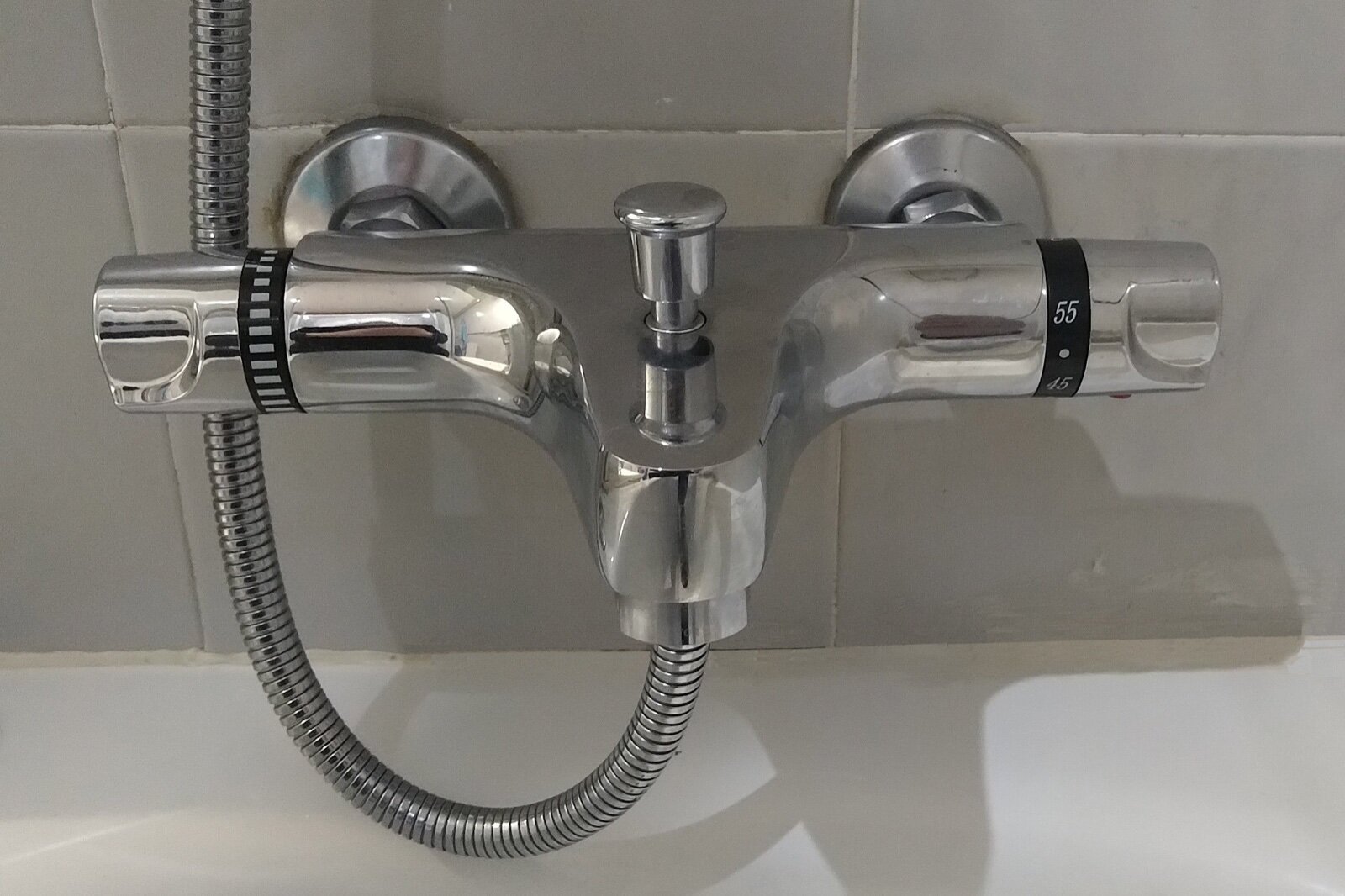

The four temperatures in the rules
| Figure | Where it comes from | What it controls |
|---|---|---|
| 48°C maximum | Building Regulations G3(4); Approved Document G para 3.65 | Hot water delivered to a fixed bath in a new dwelling or one formed by a change of use |
| 60°C maximum distributed | Approved Document G para 3.64 | Where stored water can exceed 80°C in normal use (heat stores, solar or solid fuel cylinders), a tempering valve keeps the supply to the house at or below 60°C |
| 100°C maximum stored | Building Regulations G3(3) | Every hot water storage vessel needs safety devices so stored water can never pass boiling point |
| At least 60°C stored, 50°C within a minute at the tap | HSE legionella guidance | Legionella control where a landlord or employer has a duty; good practice for homes |
What G3(4) actually says
The requirement reads: "The hot water supply to any fixed bath must be so designed and installed as to incorporate measures to ensure that the temperature of the water that can be delivered to that bath does not exceed 48°C." Approved Document G adds that the requirement is met if the outlet temperature suits the appliance and "any device to limit the maximum temperature that can be supplied at the outlet can not be easily altered by building users."
Three details are worth noticing. It is a limit on the water that can be delivered, so a dial that goes past 48°C does not comply even if you never turn it that far. It covers fixed baths only: there is no equivalent 48°C cap on showers, basins or kitchen sinks in Part G. And the limiting device must be tamper resistant in ordinary use, which rules out relying on the boiler's own temperature knob.
When the 48°C rule applies to your project
Requirement G3(4) applies only when a dwelling is erected, or formed by a material change of use under regulation 5(a) or (b) of the Building Regulations: a building being used as a dwelling where it previously was not, or a building that now contains a flat where it previously did not. In practice that means:
- Caught: a new-build house or flat; converting an office, shop or pub into flats; splitting a house into flats; turning a barn or mews garage into a separate home.
- Not caught: replacing a bath in an existing house; refitting a family bathroom; adding a new en-suite to an existing home; a loft conversion that adds a bathroom to the same dwelling.
The second list is where most of our London projects sit, and the regulations leave the decision to you. We still recommend a thermostatic bath control in any home with young children, older relatives or anyone with reduced sensation, because the cost is modest and a bath is where the worst scalds happen: someone gets in, or is put in, before the water has been tested.
If the bathroom work is part of a wider renovation that does need building control, see our overview of building regulations for London renovations and the rules for en-suites and wet rooms.
How to meet it: the valve and the pipework
Approved Document G paragraph 3.65 says the bath supply should be limited to 48°C "by use of an in-line blending valve or other appropriate temperature control device, with a maximum temperature stop and a suitable arrangement of pipework." There are two common ways to do it.
- A thermostatic bath or bath-shower mixer on the wall or deck, with a factory or installer-set maximum stop. Neat, visible and easy to service, and the usual choice in a designed bathroom.
- A concealed thermostatic mixing valve (TMV) in the pipe run to the bath, under the bath panel or behind an access hatch, feeding ordinary taps. Useful when the client wants traditional pillar taps or a freestanding bath filler that has no thermostat of its own.
Paragraph 3.66 sets the test: the valve should comply with BS EN 1111 (high pressure thermostatic mixing valves) or BS EN 1287 (low pressure ones), which shows that 48°C cannot be exceeded in operation and that the valve fails safe, shutting off rather than discharging hot water if the cold supply fails. Domestic valves tested to these standards are usually sold as TMV2 approved. Match the valve to the system: a high pressure valve for a combi or unvented cylinder, a low pressure one for a gravity-fed system with a loft tank (para 3.67).
Two layout points from paragraph 3.68 matter at design stage. Keep the pipe between the valve and the outlet as short as possible, because a long run of lukewarm water is where bacteria grow; HSE guidance for managed buildings says pipe runs downstream of a TMV should not exceed 2 metres. And if the bath will be used rarely, for instance in a guest suite, the system should allow a high temperature flush to pasteurise the pipework, managed so nobody gets in during it.
Plan an access panel for a concealed TMV. Valves need servicing and their filters clog in hard-water areas, which covers most of London; a TMV sealed behind tiles with no hatch is a future repair bill.
The other limits: 60°C and 100°C
Where the water in a storage vessel can exceed 80°C in normal use, which happens with thermal stores and cylinders heated by solar collectors or solid fuel boilers without intervening controls, paragraph 3.64 calls for an in-line tempering valve to BS EN 15092 so that the water sent round the house does not exceed 60°C. This is a whole-house valve at the cylinder, separate from the 48°C valve at the bath.
Requirement G3(3) then caps stored water at 100°C under any circumstances. A vented cylinder needs a vent pipe plus a device that stops the temperature passing 100°C; an unvented cylinder needs at least two independent safety devices and a visible, safe discharge route through a tundish. The details, including discharge pipe sizing, are in our page on unvented cylinder regulations.
Legionella: why you cannot just turn the cylinder down
A common response to scald worries is to set the cylinder thermostat low. That swaps one risk for another. The Health and Safety Executive's legionella guidance says hot water should be stored at 60°C at least, and should reach at least 50°C within one minute of running the tap; cold water should be below 20°C after two minutes. Those figures are a legal duty for landlords and employers and sensible practice for everyone else. The way to get safe water at the bath and clean water in the cylinder is to store hot and blend at the outlet, which is exactly what the TMV does.
Heat pump owners face the same trade-off in a different form, because heat pumps run most efficiently at lower cylinder temperatures; most systems run a periodic high temperature cycle to deal with it. Ask your installer how theirs is set.
A specification checklist for a new bathroom
- Establish whether the project is a new dwelling or a change of use. If it is, the 48°C bath limit is mandatory and building control will check it.
- Choose a thermostatic bath mixer or a separate TMV tested to BS EN 1111 or BS EN 1287, matched to your water pressure.
- Set the maximum stop at commissioning and record it; the stop must not be easily overridden.
- Keep the pipe from valve to spout short, and design an access hatch for any concealed valve.
- Keep stored hot water at 60°C or above and fit a tempering valve if the cylinder can exceed 80°C.
- Combine this with the electrical rules in bathroom zones and, for design ideas, our bathroom design how-to.
Sources: The Building Regulations 2010, Schedule 1 Part G, and Approved Document G (2015 edition incorporating 2016 and 2024 amendments), requirement G3 and paragraphs 3.64 to 3.68, checked October 2026; HSE guidance on controlling legionella in hot and cold water systems. These rules apply in England; Wales and Scotland publish their own guidance. Start a project from the Vertigo Interiors homepage.
Frequently Asked Questions
Is it a legal requirement to have a TMV on a bath in the UK?
In England it is required only for a fixed bath in a new dwelling, or in one formed by a change of use such as converting a building into flats. Building Regulations G3(4) caps the water delivered to that bath at 48°C, and a thermostatic mixing valve is the usual way to meet it. Refitting a bath in an existing home does not trigger the rule.
What is the maximum hot water temperature for a bath?
48°C at the bath outlet, under requirement G3(4) and paragraph 3.65 of Approved Document G. Many installers set the stop a little lower for comfort, but the regulation figure is 48°C.
Does the 48°C limit apply to showers and basins?
No. Part G sets the 48°C limit for fixed baths only. Showers, basins and sinks have no equivalent cap in Approved Document G, although thermostatic showers are widely fitted for comfort and safety.
What temperature should my hot water cylinder be set to?
HSE legionella guidance says hot water should be stored at 60°C at least and reach 50°C at the tap within one minute. Turning the cylinder down to prevent scalds raises the legionella risk; blending at the outlet with a TMV is the safer answer.
Which standard should a thermostatic mixing valve meet?
Approved Document G points to BS EN 1111 for high pressure thermostatic mixing valves and BS EN 1287 for low pressure ones. Valves tested to these standards are usually sold as TMV2 approved for domestic use.
Do I need building control approval to fit a thermostatic bath mixer?
Swapping a bath mixer in an existing home is not normally building work in itself. Where the bath is part of a new dwelling or a conversion, building control will check the 48°C limit as part of the wider application.