
Choosing an interior designer in London is a strange kind of shopping. You are buying judgement and project management, not a product you can hold, and you are usually committing a serious budget to someone on the strength of a meeting and a few photographs. The good news is that the homeowners who end up happy almost always do the same things before they sign. They shortlist deliberately, they read portfolios for the right things, they ask sharp questions, and they treat a written proposal as a document to scrutinise rather than a formality.
This guide is about that selection stage. It assumes you already know roughly what you want to spend, which is a separate question covered in our London cost guide, and that you understand what the relationship looks like once it starts, which our guide to working with an interior designer sets out. Here the single job is choosing the right firm before any money changes hands.
Build a shortlist worth comparing
Start with three or four designers, not one and not ten. One gives you nothing to measure against; ten turns the process into a part-time job. The aim is a small group whose work you already half like, so the meetings are about fit rather than first impressions.
Three sources tend to produce a strong shortlist. The first is people you trust who have actually completed a project, not just admired one. The second is the work itself: designers who keep publishing rooms in your style, in properties like yours, in areas you recognise. The third is the British Institute of Interior Design, whose public register of designers lets you find and confirm accredited professionals near you. Because the title interior designer is not legally protected in the UK, anyone can use it, so a register that verifies standing is genuinely useful at this stage.
Weight your shortlist towards designers with London experience that matches your property. A studio that mainly delivers new-build apartments is a different proposition from one that routinely works on period conversions, listed buildings or leasehold flats. The capital's housing stock is demanding, and relevant experience saves you from paying someone to learn on your project.
How to read a portfolio properly
Most people look at a portfolio for whether the rooms are pretty. That is the least useful question, because almost every published room is. Look instead for three things.
- Range and consistency. Can the studio do more than one look, and does it do each one well? A portfolio that is all the same scheme tells you they have a house style; a portfolio that is all over the place can mean they follow the client closely or that they have no point of view. Decide which you want.
- Property type. Look for homes like yours. A beautiful Shoreditch warehouse conversion does not prove a designer can handle a panelled Kensington townhouse with a freeholder and a planning officer attached.
- Evidence it was real. Photographs are styled. Ask which projects they managed end to end, what the brief and budget were, and what changed along the way. A designer who can talk you through a real project, including the bits that went sideways, is showing you how they work, not just what they produce.
If a designer cannot show completed work at all, or only mood boards and renders, treat that as a serious gap. You are about to trust them with delivery, and delivery is exactly what a render does not prove.
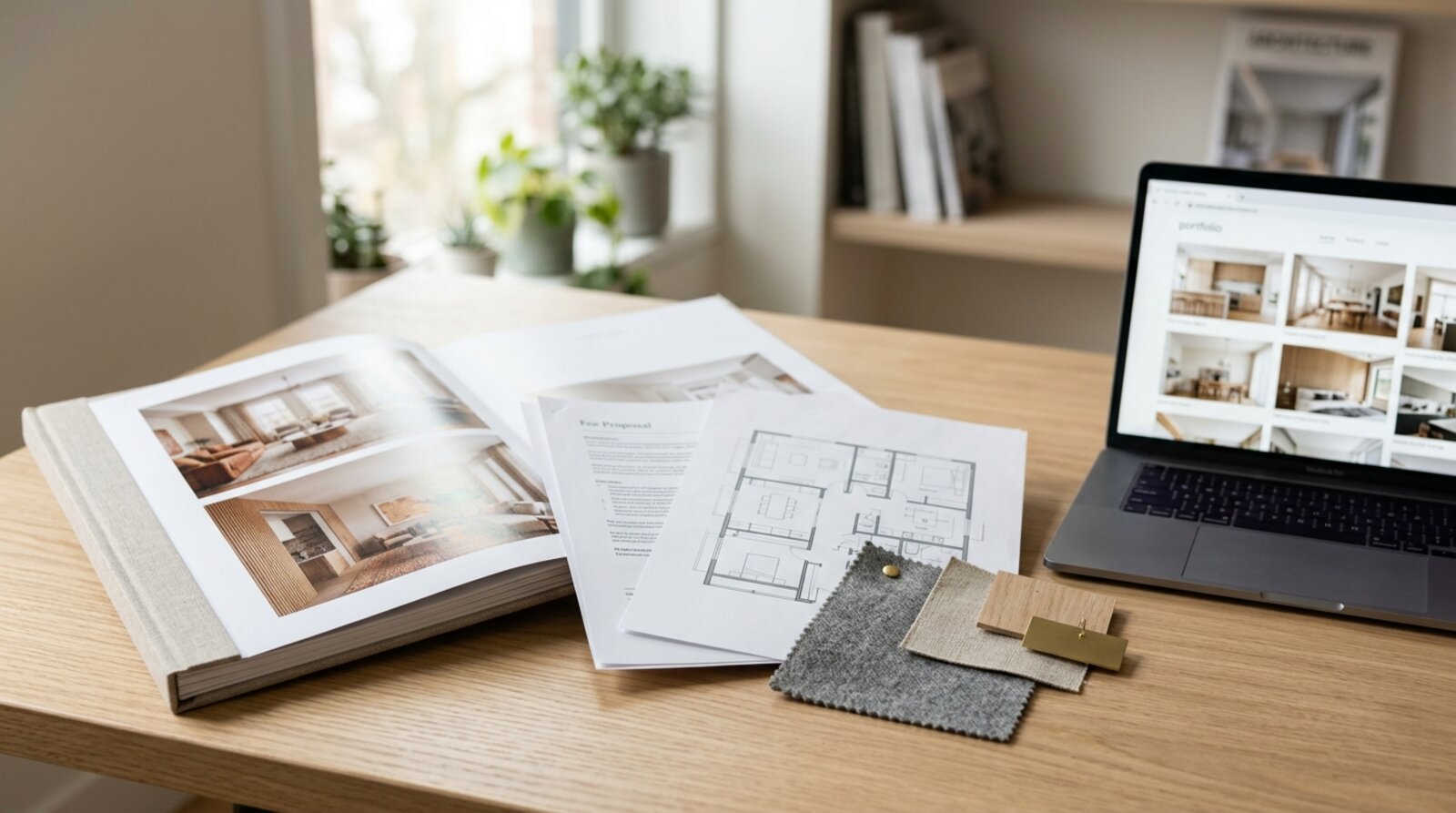
The questions to ask at a first consultation
A first meeting is a two-way interview. The designer is reading whether your project suits them; you should be doing the same. Ask the questions that surface how they actually operate, then listen to how clearly they answer as much as to what they say.
- Who will run my project day to day? The principal you meet is not always the person managing your build. Ask who your contact is, who attends site, and how often.
- How do you charge, and what does the fee include? Hourly, day rate, per room or a percentage of the project. Then the harder part: does the fee cover procurement, site visits, revisions and trade liaison, or are those extra? Get the answer in writing.
- Have you done my type of project, in my type of property? Period flat, listed house, leasehold apartment, whole-home refurbishment. Ask for a recent example you can see.
- What happens if we go over budget or over time? A confident answer describes a process. A vague one tells you overruns are handled by surprise invoices.
- How are revisions handled? How many rounds are included before changes are charged, and what counts as a change.
- How do you manage trades and contractors? Do they bring their own vetted trades, work with yours, or step back once the design is done? This decides how much of the project you carry.
- Can I speak to two or three recent clients? A designer with happy clients will offer references without hesitation.
Pay attention to communication itself. You may be working with this person for six months or more, through decisions, delays and money. If a first conversation already feels like hard work, or if your questions are met with impatience, that does not improve once you have signed.
How to compare quotes and proposals fairly
Two proposals can look hundreds or thousands of pounds apart and actually be the same price, or the same on paper and wildly different in what they deliver. Compare them properly.
First, make sure every studio is pricing the same brief. Hand each of them the same written summary of scope, rooms and budget, so the numbers come back comparable rather than each priced against a different assumption. Second, check that the proposal separates the design fee from the build and furnishing budget. These are different pots of money, and a proposal that blends them into one figure is hiding something you need to see. Third, read what is included against what is billed as an extra. A lower fee that excludes project management, site visits or procurement is not the saving it looks like once you add those back.
A good proposal is specific. It states the scope, the fee model, the payment stages tied to milestones, what is and is not included, and a realistic timeline. If a quote is a single number with no breakdown, ask for one before you compare it to anything.
Check credentials, insurance and references
This is the part most homeowners skip and later wish they had not. Because the profession is unregulated by title, the checks fall to you.
- BIID standing. Confirm membership on the institute's register. Registered Interior Designers must hold the right professional insurances and demonstrate continuing professional development each year to keep their accreditation, which is a meaningful filter.
- Insurance. Ask to see current professional indemnity and public liability cover. Professional indemnity protects you if their advice causes a costly mistake; public liability covers injury or damage on site. No cover is a reason to walk.
- References. Speak to recent clients, ideally with projects like yours, and ask the unglamorous questions: did it run to budget, did it run to time, and how were problems handled.
- Trade accounts and relationships. Established studios hold trade accounts with suppliers and work with known contractors. Ask how they buy and who they build with, because their network becomes yours for the duration of the project.
Contract and deposit red flags
By the time you are handed an agreement, you should already be fairly confident. The contract stage is where you confirm that confidence, or catch the warning you missed. Treat the following as reasons to pause or walk away.
- Nothing in writing. No written scope, fee, payment schedule or timeline. A handshake is not a contract for a five-figure project.
- A large up-front deposit with nothing defined in return. Staged payments tied to milestones are normal and sensible. A big lump sum before any work is scoped is not.
- No portfolio of completed work, or only renders. You cannot judge delivery from images that were never built.
- No insurance, or evasiveness when you ask. A professional expects this question and answers it plainly.
- Vagueness about who supervises the site. If nobody clearly owns the build, problems land on you.
- Pressure to sign quickly. Urgency is a sales tactic, not a sign of a good designer. Reputable studios are busy and can wait for you to read the contract.
- Fee and build budget merged into one number. It makes the proposal impossible to check and is rarely an accident.
London considerations that change the choice
Some of the most important questions are specific to the capital, and a designer who raises them unprompted is showing you they know the territory.
If you own a leasehold flat, your lease will usually require the freeholder's written consent for structural or significant alterations, and securing it takes time you need to plan for. Period and listed properties, and homes in conservation areas, can need planning permission or listed building consent, with all the lead time that implies. Access and logistics matter too: parking, deliveries, lift access in mansion blocks and restricted working hours all shape how a London project runs. A designer who knows your area will factor these in from the start. One who never mentions consents or access is either inexperienced with London stock or not thinking far enough ahead, and either way you should ask.
Making the decision
When you have met your shortlist and read their proposals, the choice is rarely the cheapest fee or the prettiest portfolio in isolation. It is the designer whose work fits your taste, who has done your kind of project in your kind of property, who priced a clear and itemised proposal, who holds proper credentials and insurance, and who you can imagine talking to honestly for the length of the job. Get those aligned and the decision tends to make itself.
If you would like to put these questions to us, book a consultation and we will walk you through our portfolio, our credentials and a written proposal you can compare against anyone else's. You can also start at our homepage to see how we work.
Frequently asked questions
How do I check an interior designer's credentials in London?
The title interior designer is not legally protected in the UK, so anyone can use it. The most reliable check is the British Institute of Interior Design (BIID), the country's professional body for the field. Its public register lets you confirm whether a designer holds Registered Interior Designer status. Registered members must hold professional indemnity and public liability insurance and prove ongoing professional development to keep their accreditation. Beyond that, ask to see proof of current insurance and speak to two or three recent clients with projects similar to yours.
What questions should I ask an interior designer at the first consultation?
Ask who will actually run your project day to day, how they charge and what the fee includes, whether they have done projects of your type and property age, how they handle going over budget or over time, how revisions are dealt with, and how they manage trades and site visits. Ask to see a sample fee proposal and a recent project of similar scope. The answers tell you as much about how they communicate as about their competence.
What are the biggest red flags when hiring an interior designer?
Walk away from a designer who will not put the fee, scope and payment stages in writing, who asks for a very large deposit with nothing defined in return, who cannot or will not show a portfolio of completed work, who has no professional indemnity insurance, who is vague about who supervises the site, or who pressures you to sign quickly. A proposal that blurs the design fee and the build budget into a single number is also a warning sign.
How do I compare quotes from different London interior designers?
Compare like for like, not just the headline number. Check whether each quote covers the same scope, whether the design fee is separated from the build and furnishing budget, and what is included versus charged as an extra, such as procurement, site visits, revisions and trade liaison. A cheaper fee that excludes project management is not cheaper once you add it back. Ask every studio to price against the same written brief so the quotes are genuinely comparable.
Do I need freeholder or planning consent before starting a London project?
Often yes. If you own a leasehold flat, your lease usually requires the freeholder's written consent for structural or significant alterations, and getting it can take time. Period and listed properties, and homes in conservation areas, may need planning permission or listed building consent. A London designer who knows the local stock should raise these points early and factor the timeline in. If they do not mention consents at all, ask.
Should I choose the cheapest interior designer?
Not on price alone. The right choice balances a fair, clearly itemised fee with a portfolio that matches your taste, relevant experience with your type of property, proper insurance and credentials, and communication that suits you. A low fee that hides extras, skips project management or comes from someone you cannot reach is rarely the saving it looks like at the quote stage.