Home › Guides
Regularisation Certificates: How to Legalise Work Done Without Building Control
Somebody removed a wall, converted a loft or fitted a new bathroom and never told building control. It happens constantly, and it usually surfaces at the worst possible moment, when a buyer's solicitor asks for a completion certificate that does not exist. A regularisation certificate is the route back, and the rules around it changed significantly in 2023 in a way most homeowners have not registered.
What a regularisation application is
It is a retrospective building control application. You tell the local authority what was built, when, and by whom if you know. The authority arranges to inspect the work, and that inspection determines whether the work complies or what has to be done to make it comply. If the work is brought up to standard, the authority issues a certificate of regularisation.
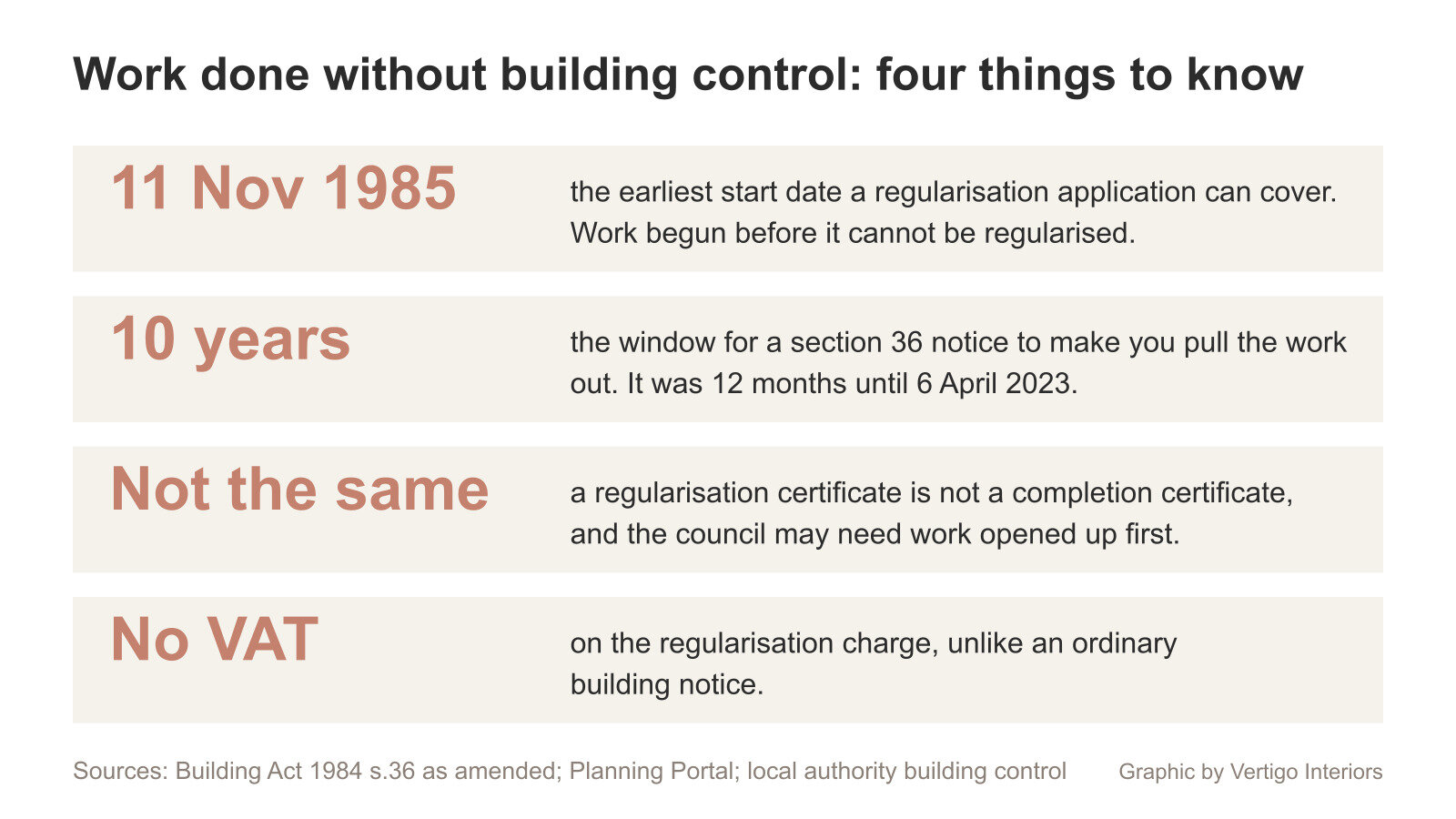
Two limits define the scheme. It only covers work that needed building regulations approval in the first place, and it only covers work started on or after 11 November 1985. Work begun before that date cannot be regularised at all, which is why very old alterations are usually dealt with through an indemnity policy rather than an application.
The change that matters: twelve months became ten years
For decades the working assumption in the trade was that a council could not force you to undo unauthorised work once twelve months had passed since completion. That was section 36 of the Building Act 1984, which lets an authority serve notice requiring offending work to be removed or altered, and which used to carry a twelve-month cut-off.
The Building Safety Act 2022 replaced that period with ten years. In England the change took effect on 6 April 2023. So a kitchen extension finished in 2019 with no building control involvement is still within the enforcement window today, and will be until 2029.
This has two practical consequences. If you are selling, the "it's more than a year old, nobody can touch it" line no longer works and a well-briefed buyer's solicitor will know that. If you are buying, a property with unrecorded work completed since 2013 carries a live risk rather than a theoretical one.
Regularisation versus an indemnity policy
These are not competing versions of the same thing, and treating them as if they were is the commonest mistake in a conveyancing chain.
| Regularisation | Indemnity policy | |
|---|---|---|
| What it does | Establishes whether the work complies, and fixes it if not | Insures against the cost of enforcement action |
| Makes the work safe | Yes, that is the point | No |
| Speed | Weeks, sometimes months | Same day |
| Survives contact with the council | It is the council | No: approaching the authority voids it |
| Best for | Structural work, loft conversions, electrics, anything safety-critical | Old, minor, low-risk work where nobody can now establish what was done |
The one-way door is worth spelling out. Once you have contacted building control about a specific defect, you generally cannot then buy an indemnity policy for it. So decide the route before you pick up the phone, not after.
What the process actually involves
- Establish the start date. Anything begun before 11 November 1985 is outside the scheme. Photographs, invoices, old listings and previous sale packs all help.
- Apply to the local authority. Regularisation is a local authority function; an approved inspector cannot issue a regularisation certificate. Expect to describe the work and provide any drawings or calculations you have.
- Pay the charge. Authorities set their own scale, commonly as a multiple of the equivalent building notice charge. It is higher than a normal application, and it is outside the scope of VAT.
- Inspection, and opening up. The Planning Portal puts it plainly: exposure, removal or rectification of works may be necessary to establish compliance. In practice this can mean lifting floorboards, cutting inspection holes or digging a trial hole at a foundation.
- Remedial work. Whatever the inspector finds short has to be put right before a certificate can be issued. This is where the real cost usually sits, not in the fee.
- The certificate. Issued once the authority is satisfied. It is a certificate of regularisation, not a completion certificate, and it will normally record what was inspected and what could not be.
The work that comes up most often
Removed walls. The one that worries surveyors most, because a wall taken out without a beam calculation can be carrying more than the owner thinks. Our guide to removing a load-bearing wall in London covers what should have happened.
Loft conversions. Fire escape, floor structure, stair geometry and insulation all sit under building regulations, and an unrecorded conversion usually fails on at least one. See loft conversion building regulations.
Electrical work. Notifiable work in a dwelling has to be certified, and a missing certificate is one of the most common gaps in a sale pack. Part P and what it covers explains which jobs are notifiable.
Garage conversions and internal reconfigurations. Both regularly get done as "just decorating" and both are controlled work once insulation, ventilation or structure is involved.
If you are about to start work
The whole problem is avoidable and cheap to avoid. A building notice or full plans application costs a fraction of a regularisation plus remedial work, and it leaves you with a completion certificate that a buyer's solicitor will accept without argument. Our guide to building regulations for a London renovation sets out which route suits which project, and planning permission for internal alterations covers the separate consent regime that catches people in conservation areas and listed buildings.
If you have inherited somebody else's unauthorised work, get a structural opinion before you decide anything. A regularisation application that uncovers a serious defect is unwelcome news, but it is news you would rather have before you exchange than after. The Vertigo Interiors home page has the rest of our renovation guides.
Frequently Asked Questions
What is a regularisation certificate?
A retrospective building control application for work carried out without building regulations consent. The council inspects what was built, tells you what has to change to bring it into compliance, and once satisfied issues a certificate of regularisation. It is not the same document as a completion certificate, but it is the recognised way to put unauthorised work right on the record.
Can all unauthorised work be regularised?
No. A regularisation application can only cover work started on or after 11 November 1985. Anything begun before that date falls outside the scheme entirely, which in practice is one of the reasons an indemnity policy is still used on very old alterations. The work must also have been the kind that needed building regulations approval in the first place.
How long can a council act on unauthorised building work?
Ten years from the date the work was completed. Section 36 of the Building Act 1984 lets the authority serve notice requiring offending work to be removed or altered, and that window was extended from twelve months to ten years by the Building Safety Act 2022, taking effect on 6 April 2023 in England. The old assumption that you only had to wait a year is out of date.
Will the council make me open up the work?
Sometimes. The Planning Portal is explicit that exposure, removal or rectification of works may be necessary to establish compliance. In practice that can mean lifting a section of floor to show a joist size, cutting an inspection hole in plasterboard to prove insulation, or exposing a foundation. Budget for making good afterwards, because the council will not do it.
Is an indemnity policy better than regularisation?
They do different jobs. An indemnity policy insures against enforcement action; it does not make the work compliant and it does not tell you whether the beam is big enough. It also lapses the moment you approach the council, so you cannot buy one and then apply. For a safety-critical item such as a removed wall, a loft conversion or electrical work, regularisation is the better answer even though it is slower.
Does regularisation cost more than a normal application?
Yes, and councils calculate it differently from each other, commonly as a multiple of what the building notice charge would have been. There is one compensation: the regularisation charge is outside the scope of VAT, unlike an ordinary building control charge. Check the fee scale on your own authority's website, because the method varies.
Sources
- Building Act 1984, section 36: the power to require removal or alteration of offending work, and the ten-year limit substituted by the Building Safety Act 2022.
- Planning Portal, regularisation: the 11 November 1985 start date, the inspection process and the possible need to expose or remove work.